
$66.00 – $180.00Price range: $66.00 through $180.00
Biblical artwork: Giclee print on canvas or on fine art paper
Size 30 x 42cm (12″ x 16″)
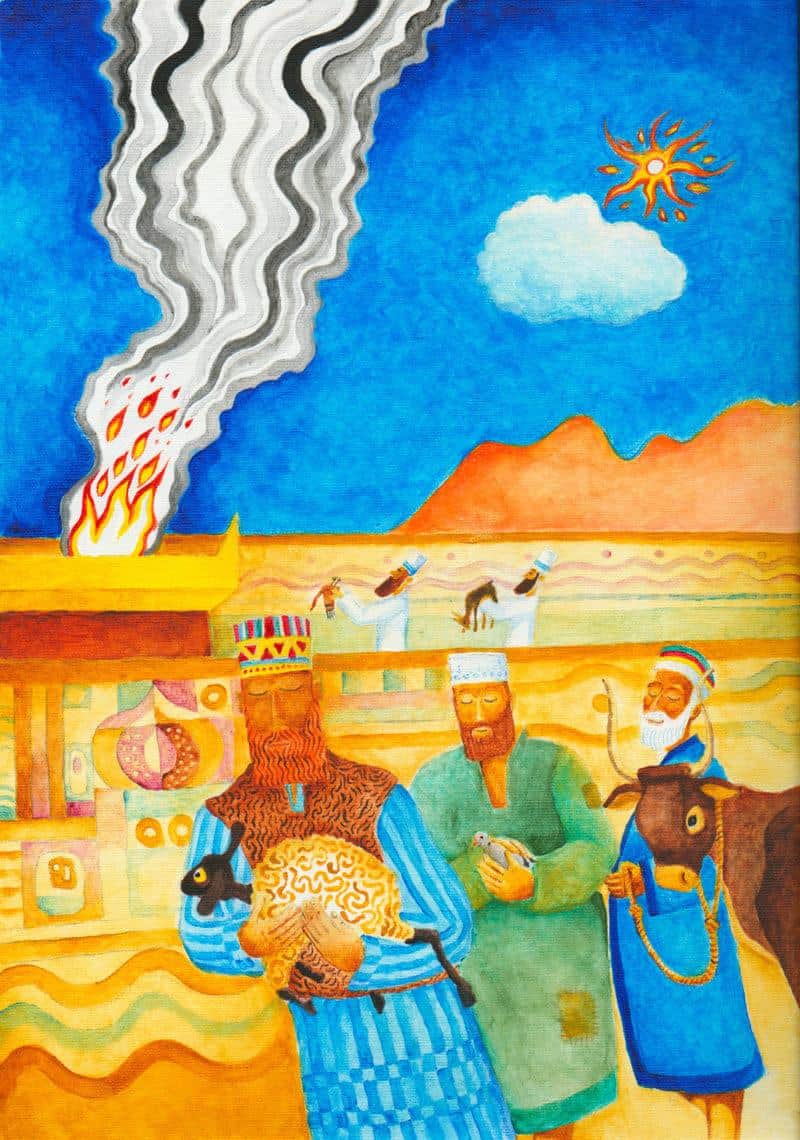
And He called to Moses, and the L-rd spoke to him from the Tent of Meeting, saying, “Speak to the children of Israel, and say to them: When a man from among you brings a sacrifice to the L-rd; from animals, from cattle or from the flock you shall bring your sacrifice. If his sacrifice is a burnt offering from cattle, an unblemished male he shall bring it. He shall bring it willingly to the entrance of the Tent of Meeting, before the L-rd.” – Leviticus Ch 1.
You can learn much more about all the Torah Parshot at the excellent and extensive Chabad site here.
And here you can see my other Biblical artwork from the Book of Leviticus.
The colours in this print of Parshat Vayikra will probably look a bit different in the actual print than on your screen, but the print will be as faithful as possible to the original artwork. Your print will be made specifically for you once you’ve placed your order.
All Images Copyright © Darius Gilmont. Unauthorised use is prohibited. To request permission please email me.

The Book of Vayikra centers on the Korbanot, the sacrificial offerings brought in the Mishkan.
The Torah opens:
אָדָם כִּי־יַקְרִיב מִכֶּם קָרְבָּן לַה׳
“When a person among you brings an offering to Hashem…” (Leviticus 1:2)
At first glance, the concept of sacrifice may feel distant, even difficult to understand in our modern world. But the Hebrew word Korban comes from the root קרב, to draw close.
Not distance, but closeness. Not loss, but elevation.
A Korban was not simply about giving something up. It was about coming closer, to Hashem, to purpose, to responsibility.
The offering was to be brought:
לִרְצֹנוֹ לִפְנֵי ה׳
“For his acceptance before Hashem” (Leviticus 1:3)
It required intention. It required effort. It required sacrifice.
And it required that the offering come from something that mattered.
We are living in a moment where the concept of sacrifice is no longer theoretical.
There are those among us who are giving everything:
• Soldiers on the front lines risking their lives
• Families living with constant uncertainty
• Entire communities disrupted, mobilized, and under threat
They are not offering from abundance, they are offering from necessity, from duty, from conviction.
And so we must ask ourselves:
What sacrifices are we willing to make?
Are higher gasoline prices too much to bear?
When others are bearing far more?
It is a simple question, but an uncomfortable one.
Because it forces us to confront a deeper truth:
When others are giving everything, what does it mean if we are unwilling to give anything at all?
Sacrifice is not only measured in grand gestures.
It is measured in priorities.
In perspective.
In whether we are willing to carry even a fraction of the burden required to confront evil and defend what is right.
The Korbanot were never about loss, they were about alignment.
They asked:
What are you willing to give in order to come closer to something greater than yourself?
The question is not whether sacrifice will be required.
The question is whether we will choose to meet the moment, or avoid it.
Even in moments of darkness, the Jewish people have always understood that sacrifice is not an end, it is a pathway.
A pathway to closeness.
To unity.
To redemption.
Just as our ancestors brought offerings to build a relationship with the Divine, we are called in our generation to rise to the moment before us, to support, to stand firm, and to ensure that those who fight on behalf of freedom are not standing alone.
We are not a people that turns away from responsibility.
We are a people that answers the call.
וַיִּקְרָא
“And He called.”
And in every generation, that call is heard again. May we have the clarity to understand the moment, and the strength to rise to it.
| Weight | N/A |
|---|---|
| Dimensions | N/A |
| Canvas or Paper |