
$66.00 – $180.00Price range: $66.00 through $180.00
Biblical art work: Giclee print on canvas or on fine art paper.
Size 30 x 42cm (12″ x 16″)
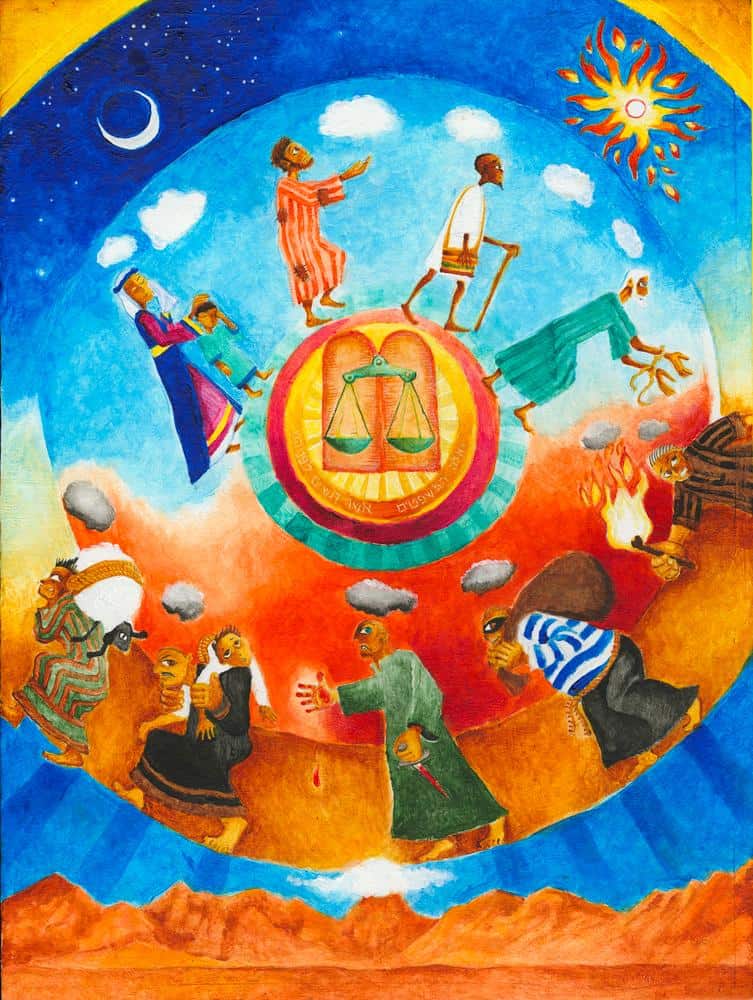
Biblical Art: Fine Art Print of Parshat Mishpatim.
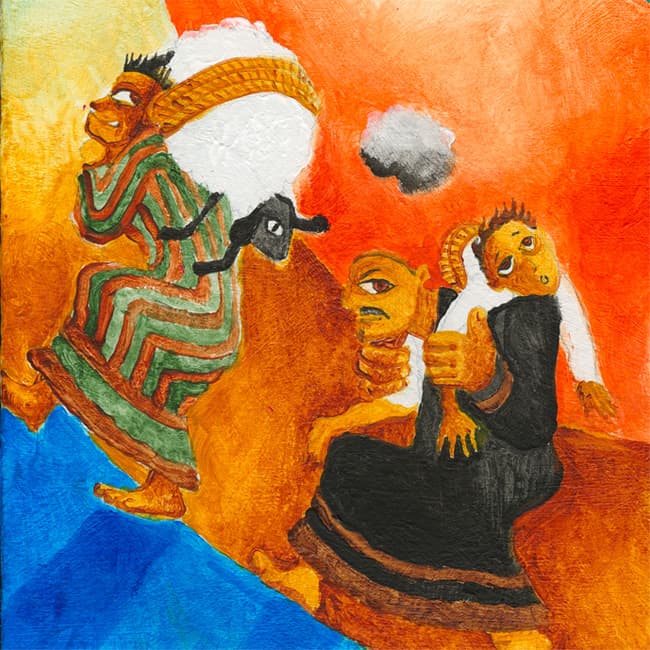
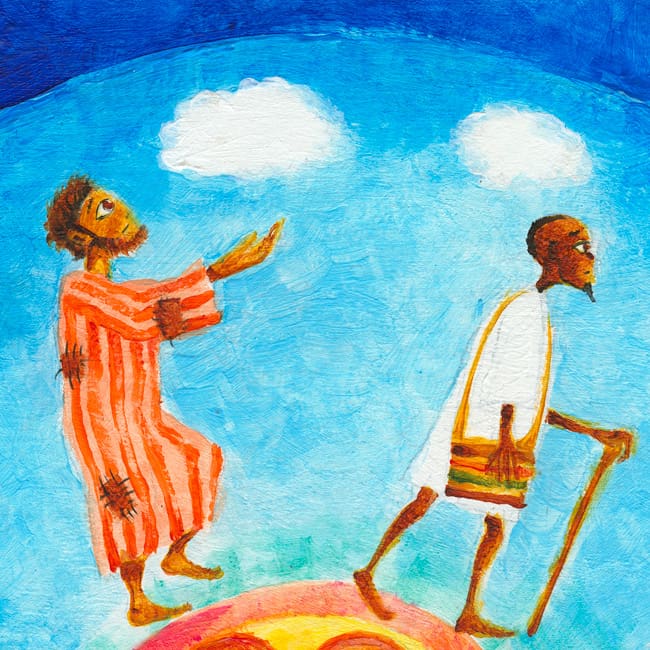
I offer this art print from the Book of Exodus as a museum-quality print on canvas. In this artwork we see various figures in a circle around the scales of justice. Each figure represents a different principle of law as laid down in Parshat Mishpatim.

At Sinai, thunder and lightning filled the sky. The Ten Commandments were given. Revelation was undeniable.
And then the Torah pivots.
Not to poetry.
Not to mysticism.
But to law.
“וְאֵלֶּה הַמִּשְׁפָּטִים…”
“And these are the ordinances…”
Rashi teaches that the word “And” links these laws directly to Sinai. Civil justice is no less Divine than revelation itself.
Justice is covenantal.
Mishpatim governs real life:
If one injures another.
If negligence causes loss.
If property is damaged.
The Torah assumes imperfection, but refuses chaos. Harm is redirected into responsibility.
Revelation inspires.
Justice sustains.
The Parsha commands protection of the vulnerable:
“You shall not oppress the stranger, for you were strangers in the land of Egypt.”
It demands honest courts. It restrains power.
And after accepting these laws, Moshe ascends once more. The people proclaim:
“נַעֲשֶׂה וְנִשְׁמָע”
“We will do and we will hear.”
Action precedes understanding.
Structure precedes stability.
Revelation without structure collapses.
Emotion without boundaries becomes chaos.
Freedom without law becomes tyranny.
Revolution promises freedom.
Covenant demands responsibility.
Revolution seizes power.
Covenant restrains it.
Not every wound is visible.
Not every injury draws blood.
But a society without structure will continue to bleed internally.
Mishpatim is the Torah’s answer to the bleed.
When trauma threatens to unravel a people, law binds them together. When fear destabilizes trust, accountability restores it. When rage tempts vengeance, covenant channels justice instead of chaos.
Harm may occur.
But harm does not prevail.
Responsibility does.
Repair does.
Covenant does.
The world celebrates spectacle. Regimes commemorate revolutions while silencing their citizens. Theater substitutes for leadership.
But Am Yisrael builds on ordinances.
Even when the guns fall silent, the silent war of the mind rages on, yet disciplined justice prevents the internal bleed from becoming permanent.
Not denial.
Not rage.
Covenant.
Message of Hope
Mishpatim does not end with injury.
It ends with ascent.
After accepting responsibility, Moshe climbs the mountain again. The Torah does not descend into
Despair, it ascends.
The covenant is not a moment.
It is a climb.
Yes, we carry memory.
Yes, we carry vigilance.
Yes, we carry the quiet bleed of the mind.
But we also carry Sinai.
We carry Mishpatim.
We carry a system that teaches us to absorb harm without becoming it.
And we are commanded:
“כָּל־אַלְמָנָה וְיָתוֹם לֹא תְעַנּוּן”
“You shall not afflict any widow or orphan.” (Exodus 22:21)
The Torah reminds us: the measure of a society is not how it wages war, but how it protects the vulnerable. Not how loudly it declares strength, but how faithfully it shoulders responsibility.
We do not walk alone.
We do not heal alone.
We do not endure alone.
The bleed does not defeat us.
It deepens us.
It clarifies what we protect.
It binds us together.
May the One who gave us Mishpatim grant healing to every wounded soul, strength to every soldier, wisdom to every leader, and comfort to every family rebuilding.
May justice prevail over chaos.
May covenant outlast revolution.
May resilience overcome fear.
We will do.
We will build.
And we will endure.
| Canvas or Paper |
|---|