
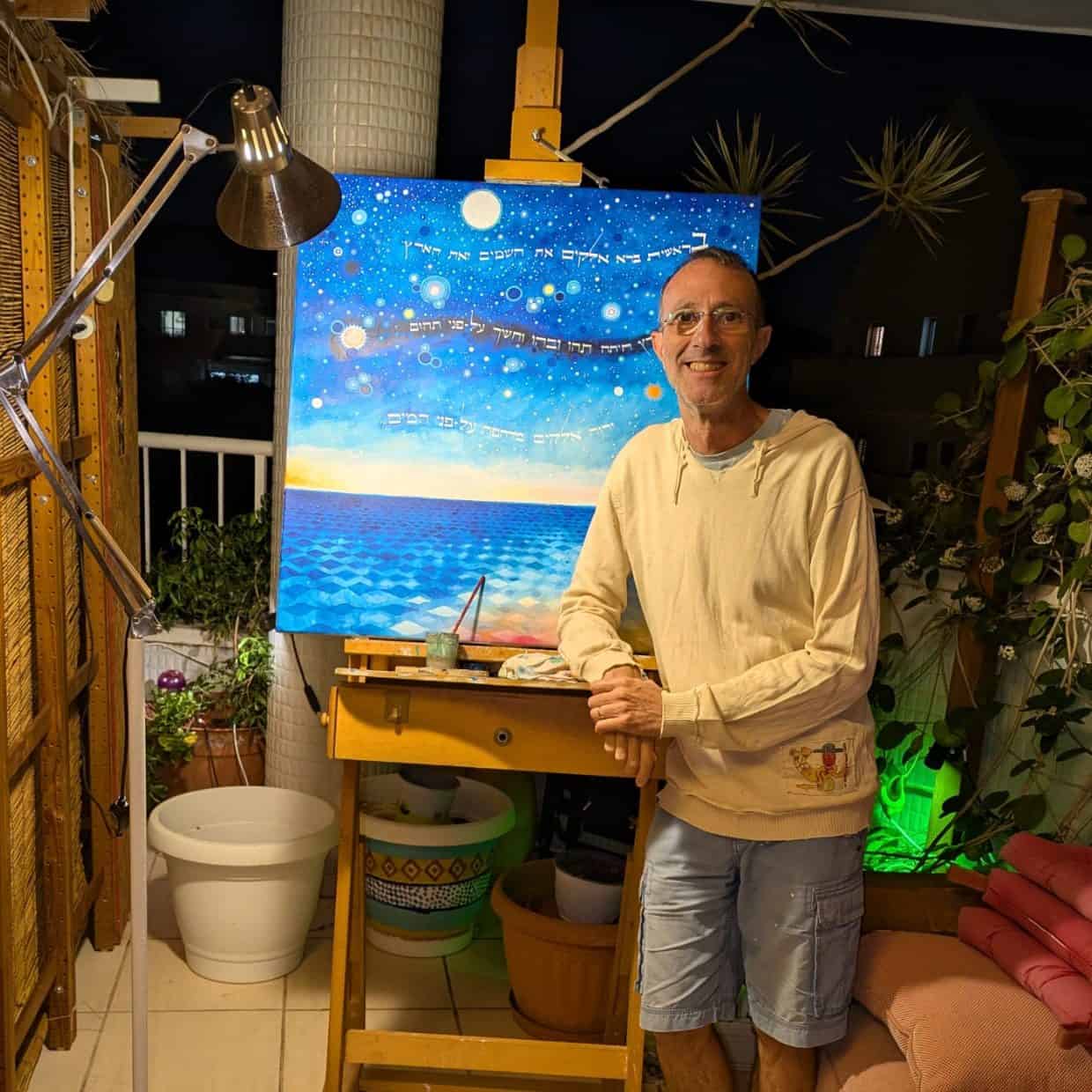
After a very difficult year, here’s me with the art of Genesis, finally starting afresh. This is a return to the beginning — a new Torah painting centered on the opening verses of Bereishit, the Book of Genesis. For Jews and Christians alike, Genesis is the foundation of biblical creation, the moment where light, time, and meaning first enter the world. This painting marks, for me, I hope, something of a new beginning.
At a time when “Globalise the Intifada” is being screamed across the world, I am taking my own stand. To counter the vulgarity, shallowness, violence and vacuity that we see all around, my art emphasizes beauty, depth, peace and meaning. I am reminding myself, and ourselves, of our heritage and what we stand for. I think this is important. We are solidifying the ground upon which we stand.
And now, back to the art: The calligraphy, which I’ve incorporated into the body of the painting, has been quite challenging. This is a completely new field for me. I’ve rediscovered an appreciation for the art of letter-making from a prized book, “Love and Joy About Letters” (1963) by Ben Shahn (about whom I wrote an excruciatingly minimal post in 2014, here). This beautiful book, infused with the artist’s love of calligraphy, was a gift to me for my Bar Mitzvah. I was in awe of it then, and still am today.
I’ve got a long way to go in calligraphy, but I’m interested in exploring how to combine lettering within paintings. For me, I think it has the potential to inspire and create deeper and more meaningful pieces. It also feels far more connected to a Jewish way of being than art without words.
Other books that I’m finding helpful in tentatively exploring calligraphy are:
Mastering Hebrew Calligraphy by Izzy Pludwinsky (2012, The Toby Press)
The Book of Letters, A Mystical Alef-bait by Lawrence Kushner (1975 & 1990, Jewish Lights Publishing)
The original painting has now been sold, but prints will be offered as soon as I can get the canvas professionally photographed. My photographer is in Bnei Brak. That’s not too far away, but it’s always quite a project to get to him, invariably involving roadworks, crazy drivers, and getting stuck in one-way systems in the strange parallel universe that is ultra-orthodox Bnei-Brak…
In any case, to make space for new work – both physical space and creative space – I’m now offering several of the original paintings of my popular Biblical art prints at a significant discount. They’re now priced at $320 each instead of $420 (not including shipping). Shipping to the USA (approx price with FedEx, DHL or similar): $120
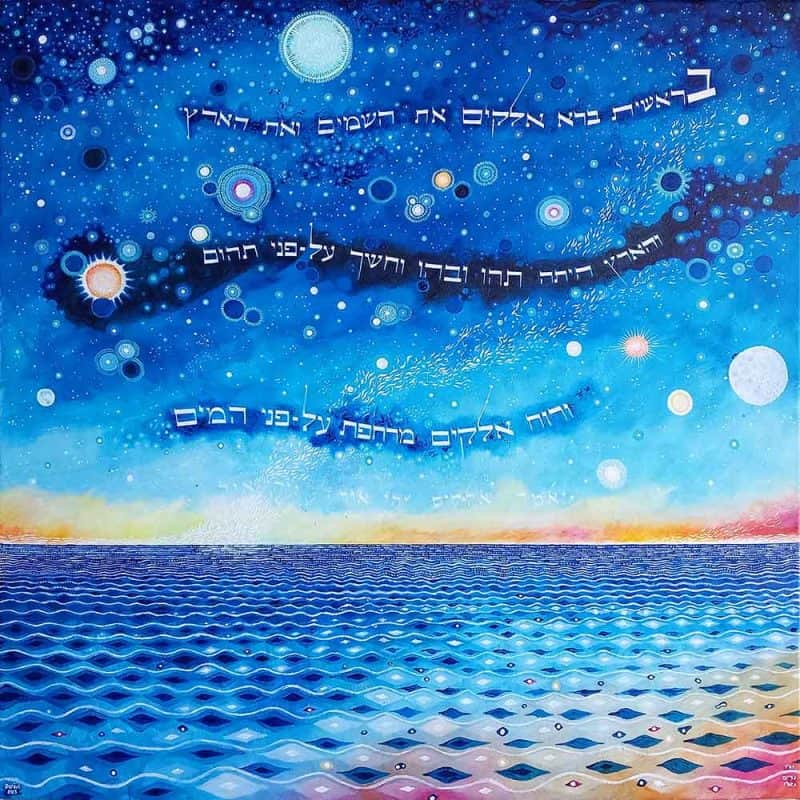
The Book of Genesis is not only the first book of the Torah; it is also a meditation on beginnings themselves—on emergence, separation, naming, and blessing. To engage with Genesis is to step into a space where nothing is yet fixed, where light is still being distinguished from darkness. It is a space of infinite depth and possibility. Painting this Bereishit artwork was all about exploring depth – a sense of which I have tried to convey in the many tones of the richest blues.
The act of painting letters—especially Hebrew letters, which carry layers of textual and mystical meaning—requires a certain discipline. Each letter resists haste and insists on intention. In Jewish tradition, the world itself was created – and is still constantly unfolding – through the Aleph-Bet. Integrating calligraphy into this painting feels not decorative but essential and almost inevitable.
There is also something rather comforting in making art that fuses word with image. Contemporary visual culture seems to put the highest value on pure impact. A painting which features the word as part of its fabric asks the viewer to to read as well as to see. This, too, is part of the art of Genesis: as creation unfolds, there is space to stop, think and reflect (“and God saw that it was good”).
Returning to Genesis after so much disruption in my own life feels almost archetypal. The text itself emerges from chaos, from tohu va-vohu, “unformed and void.” To create art in dialogue with that passage is to affirm that renewal is not naïve optimism but an active tradition in our lives, and that new beginnings are always possible.
I hope this piece is the first step in a longer exploration of the art of Genesis: How does one begin anything new? This is a question that feels as relevant in the studio as it does in daily life. There are more works to follow, I hope, and they will perhaps continue to focus on the original creation-question posed in the Book of Genesis: what does it mean to bring something into being, and to call it good?