Choosing the perfect gift is difficult. The great sages have always known this. The Buddha alluded to it in the First Noble Truth where he poignantly states: “there is suffering (dukkha) in life.” Some commentators, like Rashi (Rabbi Shlomo Yitzchaki, France, 1040 – 1105), are so traumatized by the subject that they avoid it altogether.
Others simply admit defeat or bow in deference to the enormity of the difficulty: “Choosing the perfect gift is like passing a camel through the eye of a needle,” (Ibn Mutannabi, Granada, Andalucia, 915-965). The medieval knight Thomas de Bauzan wrote that the best part of being on Crusade in the Holy Land was not having to decide what to buy for Lady de Bauzan, or their many children, at Christmas.
Today, choosing the right gift is no easier than it ever was, but at least we have the internet, where we can read articles like this. We can also look at thousands of ideas of what to buy. Sadly for our forbears, they could not access the internet, and that is why they suffered so much in trying to choose the perfect gift for their loved ones. (The internet has in fact existed, lying in a state of dormant potential, for thousands of years, but only in the late 20th century was the technology developed to finally access it).
Kings, queens, princes, prophets, and presidents throughout history have sent gifts to one another. Whether these gifts were intended as signs of esteem, as part of a political power-play, or as none-too-subtle payment for favours expected or wished-for, they were always chosen with the greatest of care. A gift was never just a gift; it was a message, a symbol, a signal of the giver’s intent.
The Hebrew Bible (Tanakh), being brutally honest about human motives, contains some of the most illuminating gift stories of all.
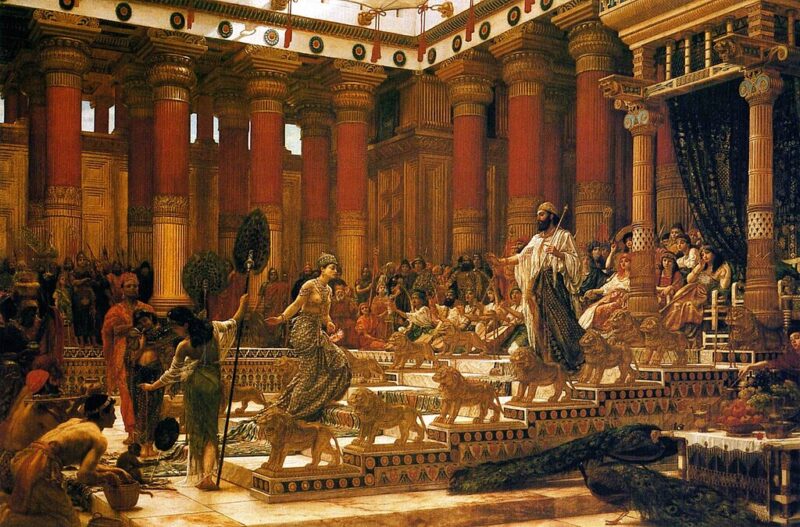
And she gave the king a hundred and twenty talents of gold, and of spices very great store, and precious stones; there came no more such abundance of spices as these which the queen of Sheba gave to king Solomon.
(1 Kings 10:10)
The Queen of Sheba’s gifts were not random luxuries. Gold, spices, and precious stones were the most valuable commodities of their time, and she brought them in quantities so excessive that the text tells us that nothing like it was ever seen again.
But the true gift here is not material wealth. The Queen comes because she has heard of Solomon’s wisdom. Her gifts acknowledge his spiritual and intellectual stature. This is gift-giving as recognition: I see who you are, and I honour it.
A meaningful gift does exactly this — it reflects back to the recipient something essential about their identity.
Not all Biblical gifts are similarly motivated. That, of course, is part of their educational value.
When Jacob prepares to meet his estranged brother Esau, whom he has previously deceived out of both birthright and blessing, he sends ahead extravagant gifts of livestock: goats, rams, camels, cows, bulls, and donkeys — all carefully counted, meticulously spaced, and delivered in waves.
Jacob himself explains the strategy:
“I will appease him with the gift that goes before me.”
(Genesis 32:20)
This is gift-giving as emotional damage control. The gift is not about beauty but about intention: reconciliation, fear, hope, and humility all wrapped together. It reminds us that a well-chosen gift can soften hearts, heal rifts, and sometimes even save lives.
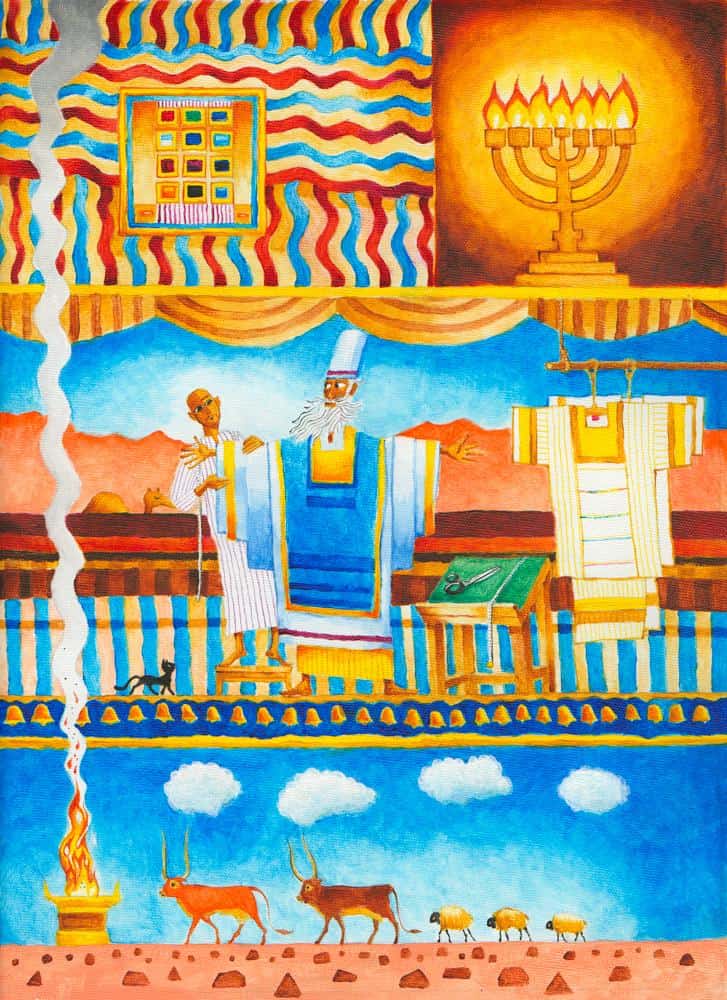
One of the most remarkable gift-giving episodes in Scripture occurs not between rulers, but between an entire people and God.
“From every person whose heart moves him, you shall take My offering.”
(Exodus 25:2)
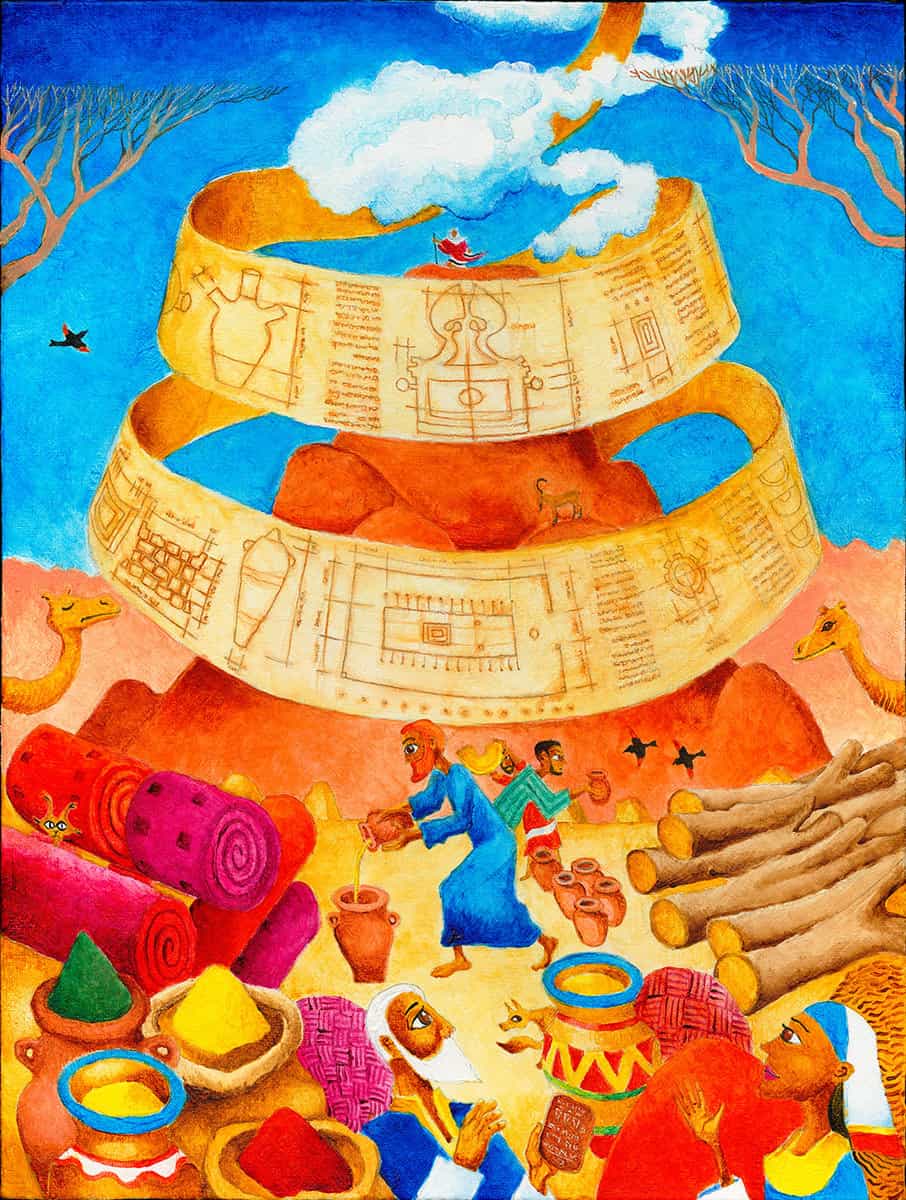
The image at the top of this post shows the Israelites bringing gifts for the construction of the Mishkan (the Tabernacle). Gold, silver, bronze, fine linen, dyed skins, precious stones — the people give so generously that Moses eventually must tell them to stop.
This is gift-giving at its highest level: freely given, beautifully crafted, and intended to create a dwelling place for holiness. Art, craftsmanship, and devotion converge. It is no coincidence that the Bible devotes such loving detail to the aesthetics of this sacred space.
Today, we live in an age where nearly everything is available, immediately, cheaply, and in infinite variations. This abundance paradoxically makes choosing a lot harder. When everything is possible, meaning becomes elusive.
Choosing the perfect gift means giving that which rises above mere utility or vanity. It must endure. It must speak.
Biblical art does precisely this. Rooted in ancient stories, layered with symbolism, and rich in spiritual resonance, it offers the recipient something more than decoration: a presence, a meditation, a conversation that continues long after the wrapping paper is gone.
A carefully chosen Biblical print or original artwork is not a generic object. It is a modern echo of the Queen of Sheba’s spices, or Israel’s offerings in the wilderness. It is a gift that says; I thought about you. I know you. This matters.
Buddha, in saying that there is in life a certain amount of unavoidable suffering, calls us to honestly face life’s imperfections. Included among these is the inevitable difficulty of finding the perfect gift for our loved ones.
By accepting this challenge and applying ourselves with care and imagination, we move closer to a small but genuine liberation. In the specific case of gift-giving, ordering a beautiful and meaningful piece of Biblical art — what the Buddha would likely classify as spiritual art — from the studio of a both pictorially- and spiritually-minded artist, can significantly ease the burden, and bring a new source of joy and meaning into the recipient’s home. Rashi would have been joyously relieved to see how easy it is, Ibn Mutannabi would have fainted in disbelief, and Thomas de Bauzan would have rushed home from the Crusades to place his order for some fine Biblical art and share in the joy of its arrival.
For some perfect gifts based on the weekly Torah portion (Parshot HaShavua), you can do worse than look at my full series.
And for some deeper insights into the significance of gifts in Parshat Teruma, please consider what Rabbi Jonathan Sacks has to contribute….