
My first conscious memory of the olive tree was the intoxicating perfume of olive-wood. When I was about seven, I was given a gift, an articulated olive-wood gorilla-doll from Spain. While articulated gorilla-dolls are not necessarily one’s first association with the ancient olive tree of the Mediterranean basin, the lovely smell was so intriguing that it made me an olive-wood afficionado for life. I loved the doll and kept it for years, and thereafter was deeply intrigued by the sight of olive-groves, and anything to do with olives.
In Israel, the olive tree is deeply symbolic. As well as being physically and metaphorically at the centre of the struggle for the Holy Land, it is also a universal symbol for the spiritual life in this hard-edged, rock-strewn material world.
The olive tree is one of the oldest cultivated trees in the Mediterranean, and holds deep symbolic significance in all the Abrahamic traditions. It thus has the potential to bring people together, even though some use it as a tool of division. As an artist, I love the olive tree not only for what it symbolizes, but also for its pure, rugged beauty. It is the embodiment of the ancient landscape of the Bible. Indeed, there are olive trees living today which are extremely ancient, with a few considered to be more than a thousand years old. There is one near Bethlehem which locals claim is five thousand years old.
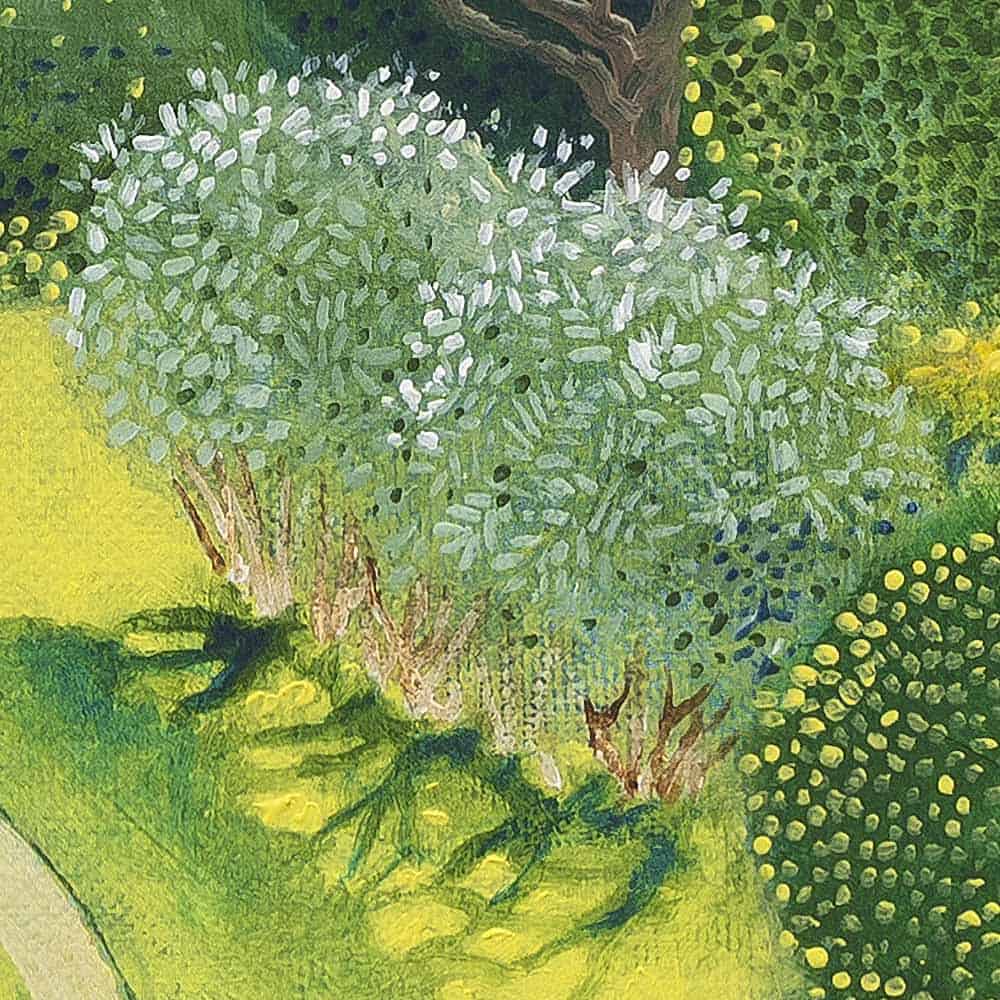
To illustrate this post with olive-tree artwork, I have chosen a few details from various paintings of mine which feature olive trees. The image above comes from my Lago Maggiore painting, showing the gardens of Isola Madre.
In the story of Noah, a newly-sprouted olive-leaf makes the olive’s first and most well-known Biblical appearance. It is a symbol of G-d’s reconciliation with man:
And the dove came in to him at eventide; and behold in her mouth an olive-leaf freshly plucked; so Noah knew that the waters were abated from off the earth. (Genesis 8.11)
Today, the olive-branch is still a universal symbol of peace and prosperity for mankind, and the olive tree still a poignant symbol of the Land of Israel. However the olive itself, and especially olive oil, represent some deeper things too:
The olive, hard and bitter when taken straight off the tree, can be a metaphor for personal spiritual transformation. Here is a Jewish interpretation:
“The olive in us is that part of ourselves that thrives on struggle, that revels in it, that would no more escape it than escape life itself. Just like an olive, say our sages, which yields its oil only when pressed, so, too, do we yield what is best in us only when pressed between the millstones of life and the counterforces of a divided self.” (From the excellent website of Rabbi Simon Jacobson, meaningfullife.com)
Perek Shirah is a rarely cited but revered work in the Jewish sacred texts, compiled by the rabbinic sages of the Mishna. The main and beautifully poetic idea behind it is that every element of creation, animals and plants, dedicate their own particular songs to G-d. (I can imagine using this exquisite work as the basis for future artwork)!
But Perek Shirah does not attribute a special song to the olive. Instead, it includes the olive tree in the general song which the trees sing.
At the same time, the Torah is likened to olive oil. It is the study of Torah, the Divine light given to us from above, that grants us the ability to “judge the earth,” to retell history in a positive manner. When the oil of the Torah judges/rectifies the entire earth, representing mundane wisdom (such as science), then indeed all the trees of the field will sing before G-d. Such is the symbolism of the olive tree in Perek Shirah. (From the website of Rabbi Yitzhak Ginsburgh, Gal Einai).
Sufi interpretations draw on Qur’anic imagery, particularly the Verse of Light (Surah An-Nur 24:35), where the olive tree symbolizes a purified soul capable of reflecting divine light. In Sufi thought, the crushing of olives represents the dissolution of ego and the emergence of inner truth through spiritual discipline.
A similar olive-centred metaphor is taken up in this modern work of Western sufi lore:
The salt that preserved the olives in their sacks is the conditioning of your life. It must be washed away before any true work can be done……The olives may be seen as the many aspects of yourself: or, each olive could be said to be one person who is potentially useful to the Work. They say that “many are called but few are chosen.”……(From The Last Barrier, by Reshad Feild, 1976, Element Books)
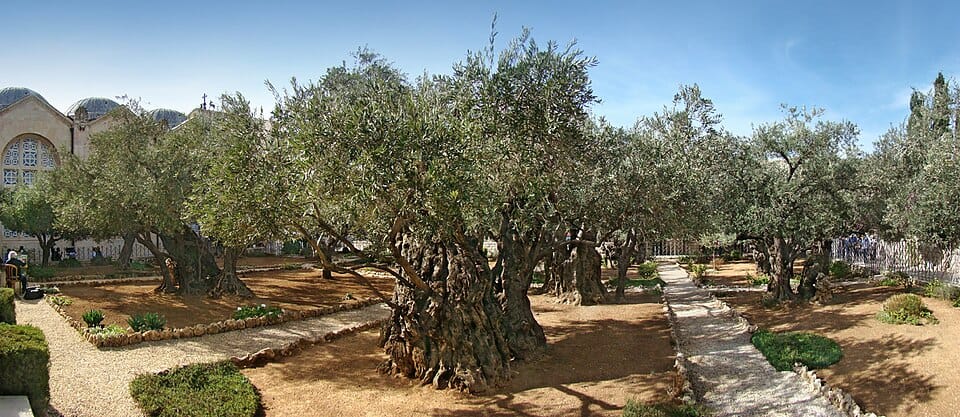
In the Christian tradition, the most potent symbolism of the olive tree lies in the Garden of Gethsemane. The name Gethsemane is a rendition of the Hebrew Gat-Shemen (meaning literally, oil press). This garden at the foot of the Mount of Olives, where Christ spent his final hours before arrest, was a place of pressing olives. In Christian contemplation, this becomes a powerful metaphor, in which the Anointed One undergoes his own trials under the crushing millstone of the press. As a result, he yields the very essence of the Christian message.
This is similar to the Jewish idea of the pressing of the olive, as a metaphor for the individual’s rite of spiritual passage. The difference being that, at Gethsemane, the metaphor applies to the redeemer’s sacrifice on behalf of all mankind (if I understand it correctly)!
As in the Jewish tradition before it, Christianity sees the symbolism of the olive tree in the light that it gives: Just as olive oil feeds the lamps of Jewish worship, so too did the same tradition pass into Christian ritual. Light, given by the olive-oil flame, is held as symbolic of the divine presence.
Traditional olive curing reflects spiritual transformation: bitterness gives way to nourishment through patience and care.
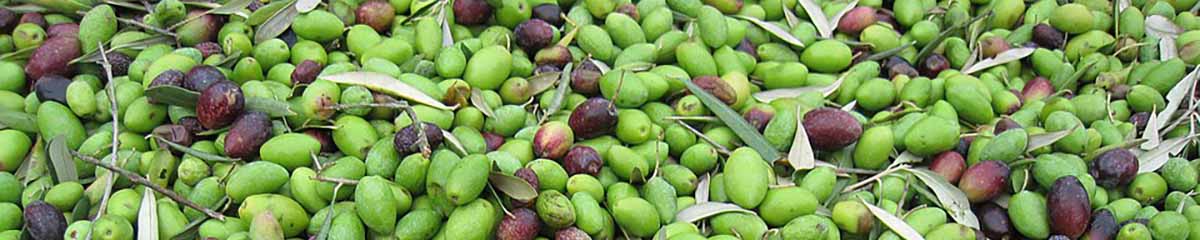
For a few years, I would cure olives every year, preparing large jars of beautiful green olives with lemon, garlic, chilli peppers, rosemary or other herbs. At some point I even added red wine. (I don’t recommend wine; it seems to soften the olives too much and reduces their longevity in storage).
As you probably understood from the above discussion, it is actually quite a lot of work to prepare olives properly, but it is a very satisfying hobby, and I became a bit obsessive about it! For the first few years, I bought raw olives in season at the market in Jaffa, but later, living in Raanana, found that there were many trees in the streets around us that had good olives, and collecting these was a favourite pastime among a small local band of dedicated enthusiasts.
Because of work and general life pressures, I haven’t made my own olives for a while, but I still keep the large jars for the golden time when I fill them again with a fresh harvest of the tough little green beasties! (By the way, there are also people who make their own olive oil at home, but I think you may call that extreme oliving….) Anyway, here is how I made my best olives:
1. Make sure the olives are not damaged by worms – dark blotches on the skin are indicative of worm infestation. Do not use blotchy olives! Choose clean, smooth, green olives like in the photo above. If they are slightly purple in part or in whole, that’s fine. It just means they’ve been on the tree longer and are more ripe.
2. Wash the olives in clean water.
3. Submerge the olives in a bucket of clean water for two weeks, changing the water every day. You will see a greasy oiliness emerge, which is the bitterness leaching out.
4. After two weeks of this, empty out the last water. Incise each olive with a small cut, or (more traditionally) bash them with a handy rock to slightly split each one.
5. Prepare very clean jars.
6. Prepare salt water (salted such that an egg will bob around on or near the surface).
7. Prepare lemons, garlic, red chilli peppers and other herbs as desired.
8. Place olives, lemons, garlic and herbs in jars.
9. Pour salt water into jars until it just covers the olives.
10. Add a small layer of olive oil on top of the water to seal in the olives, so no air is touching them.
11. Close the jars but not over-tight. (Fermentation gases will need to escape).
Leave the jars in a cool place, out of direct sunlight, for a decent Biblical length of time: forty days and forty nights. Then the olives should be ready. B’teyavon! (=Bon appetit)! Keep refrigerated once you’ve started a jar.
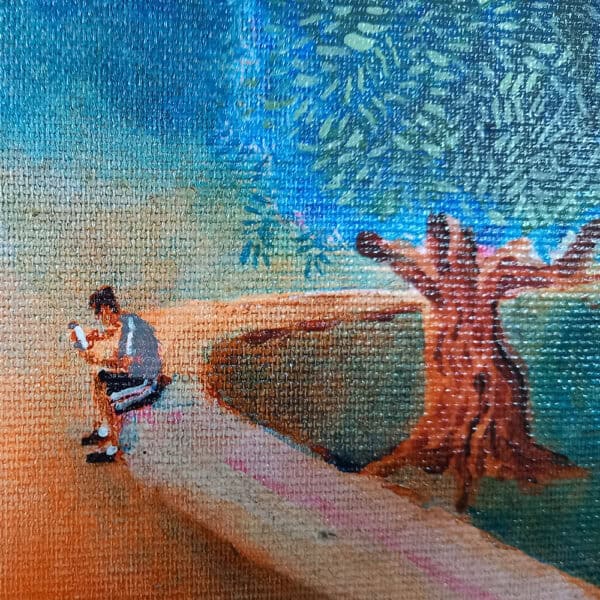
I love painting olive trees but haven’t really become an expert yet. I normally start with the basic “body” of the tree, for which I mix a slightly lighter green than for any other trees in the picture, adding a little ultramarine blue to it, because olive trees have a blue-ish hue. Then I’ll paint the basic “blob” of the tree. I’ll use a sienna brown, or burnt-umber-mixed- with-white, and delicately line out the gnarly trunk and some of the lower branches as they disappear up into the body of the tree. Later I’ll add lines or dashes in dark umber running vertically up the tree to give the impression of the deeply rutted bark of the wizened old olive.
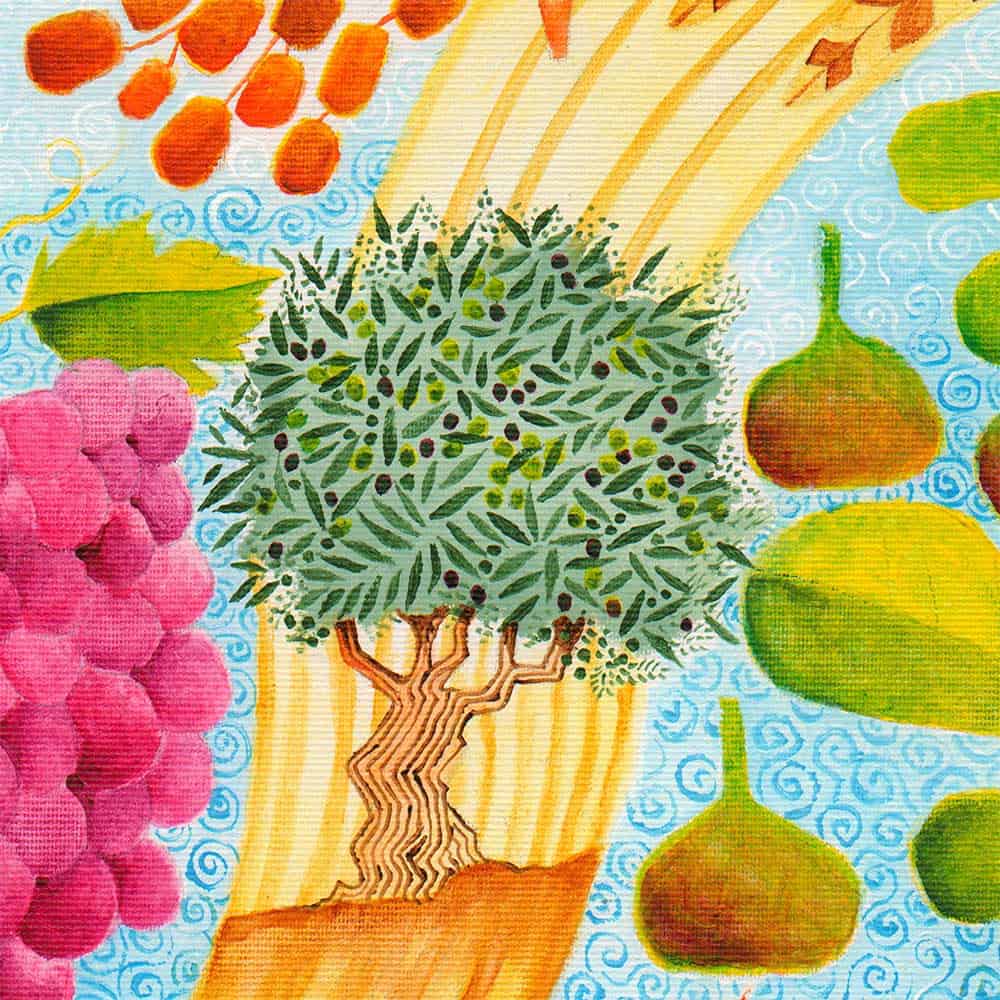
Next, the leaves: Using my finest 00 pointy brush, and a lightened version of the main body-colour of the tree, I’ll use little darting touches of the brush to put in the leaves (see example above). While I do this, I’ll be thinking about the way the leaves are arranged on the branches, so they won’t look too much like random strokes. Rather, they will have the general rhythm of olive-leaves on the tree. Obviously they’ll be way too big compared to how they would be in an ultra-realistic painting, but I’m aiming at conveying the feel and spirit of the tree, not a highly accurate scale rendering.
I hope this has given you a little inspiration, and you might like to try painting some olive trees for yourself!
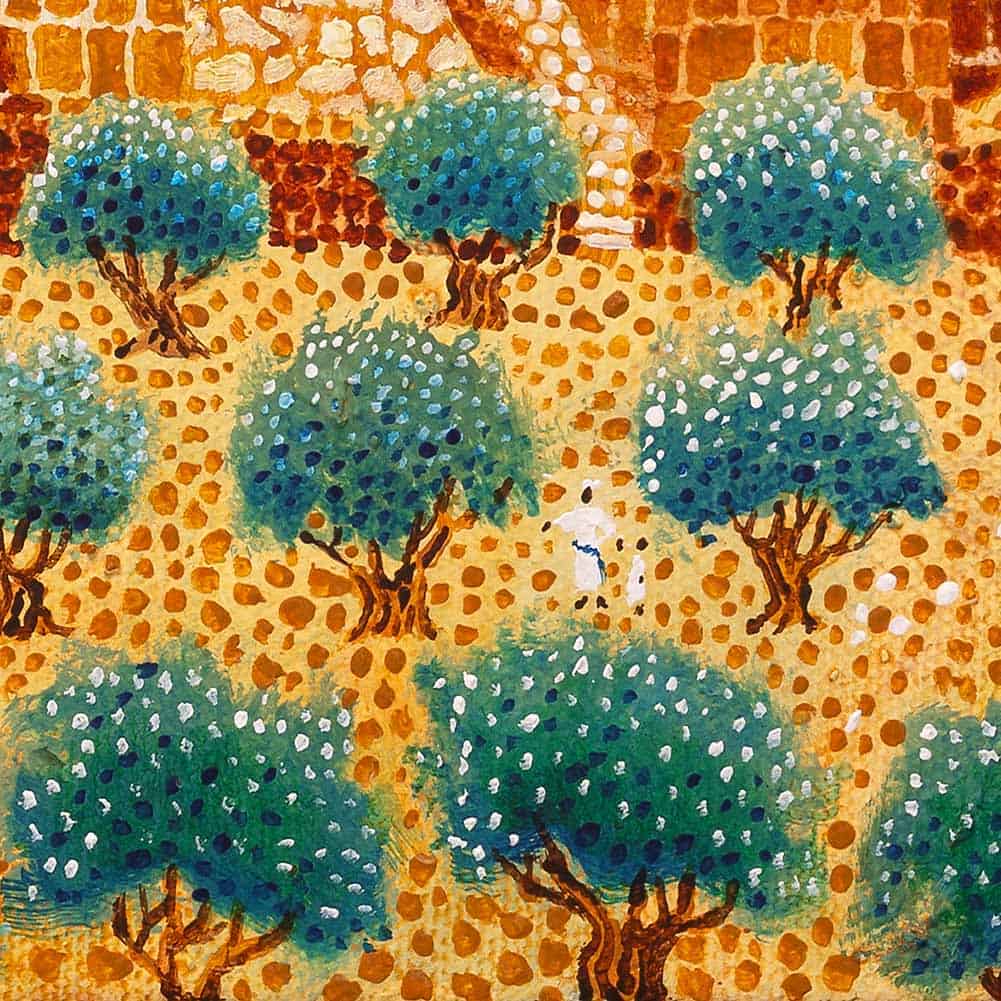
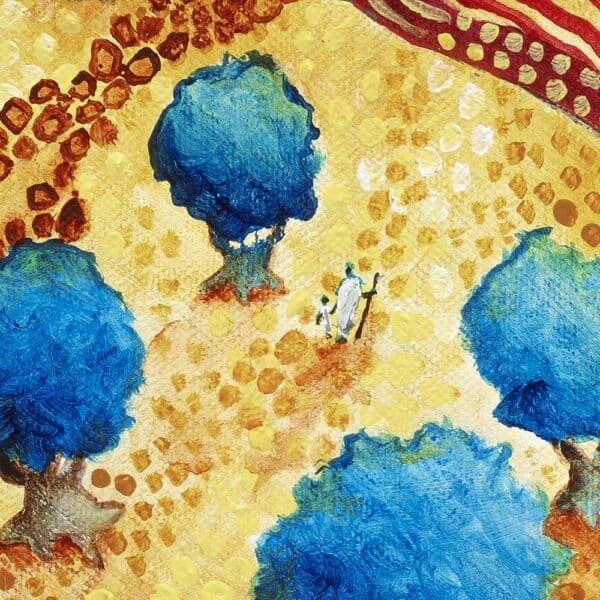
(The image below comes from a stylized painting of the hills approaching Jerusalem).
In all three traditions, the symbolism of the olive tree is as both a humble and sacred tree. It grows slowly and stubbornly and endures for centuries. It yields a fruit that is bitter, but can undergo a deep transformation. Its oil is prized for healing, nourishment, and light. This is why it serves well as a symbol of the spiritual path: the way is difficult, long and slow, strewn with rocks and strife, but the outcome is Light.
The olive tree is not only a tree of the Levant. It is a tree of the inner landscape, whose lessons can be learned by those whose heart turns, in humility but with a certain and necessary fortitude, toward the Creator, regardless of which tradition they come from.